“Risky play, involving perhaps rough and tumble, height, speed, playing near potentially dangerous elements such as water, cliffs and exploring alone with the possibility of getting lost, gives children a feeling of thrill and excitement.”
Risk is an essential component of a balanced childhood. Exposure to healthy risk, particularly physical, enables children to experience fear, and learn the strengths and limitations of their own body. …
Britain’s most decorated gymnast has seen a surge in her sport’s popularity. It’s just not what one might expect.
“We always say ‘get more women in sport’ but actually in gymnastics it’s more boys into the sport,” she told MM.
“There are plenty of boys joining in, and the fact now that they’ve got role models on the international stage like Louis Smith and Max Whitlock, that really helps because parents now also think that gymnastics is for boys as well. …
The Health Outcomes and Physical activity in Preschoolers (HOPP) Study at McMaster University (Canada) asked parents of 3- to 5-year-olds about sport participation.
87% of parents reported participation in organized activities in the last month and 90% in the last year. The sports most often reported were: swimming (79%), soccer (48%), gymnastics (40%), dance (30%), ice hockey (21%), and T-ball (9%). …
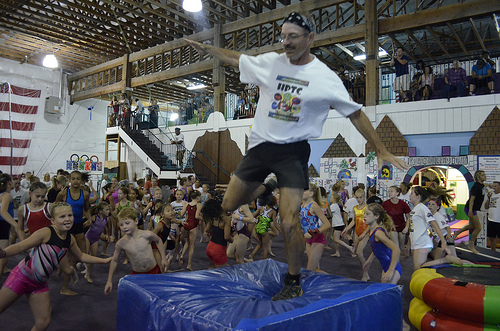
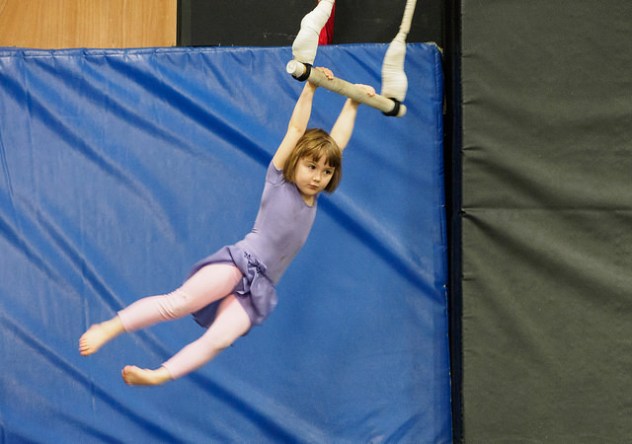
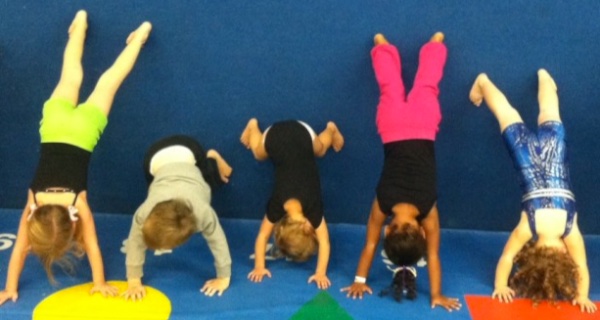
Gymnastics and Trampoline are as important as running and swimming for very young children. We teach Motor and Physical Fitness better than any other sport.
What can parents do?
Be a positive sports role model!
Emphasize the fun of sports!
Don’t focus on the rules, keeping score or competition in the early years.
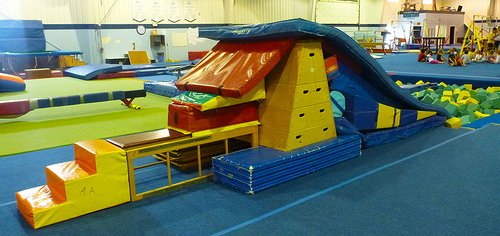
Be sure the sports program and equipment are safe and age-appropriate.
Be supportive of your child’s coach and teammates.
Kids should exercise at least one hour a day, according to the Centers for Disease Control and Prevention. But in the U.S., less than half of six- to 11-year-olds and only 8 percent of 12- to 19-year-olds meet that target. …
Over in Denmark, a longitudinal study of how schoolchildren move through urban environments provided an opportunity to find out by outfitting hundreds of students with accelerometers and GPS trackers during their waking hours. …
The researchers found that children were significantly more active when playing on grassy areas and at sites featuring playground equipment. …
… in all five areas studied, girls spent more time being sedentary than boys. …
Calgary’s media has made much ado about the city’s tobogganing rules in recent weeks — to the point where Mayor Naheed Nenshi blamed “bored journalists” trying to stir up controversy.
Now Rick Mercer has taken it upon himself to poke a bit of fun at (the) bylaw ..
(For the record, the city does not recall ever giving out a tobogganing fine. Ever.)
Certainly no Calgarian I know pays any attention to tobogganing restrictions. We slide wherever we want. But with one eye out in case a Toboggan Cop shows up. 🙂
Starting out at the age of seven, Beth went on to become an Olympic Bronze Medalist, triple World Champion, six-time European Champion, Commonwealth Champion and seven-times consecutive National Champion, cementing her place as Britain’s greatest ever-female gymnast.
Although memories of Beth taking the Bronze in the Uneven Bars at London 2012 – the culmination of an incredible career – will not be forgotten anytime soon, sharing a fierce passion for gymnastics with future generations has become her new focus.
So how can parents encourage their kids to exercise?
By making it fun for the child and getting involved themselves. If they feel involved and interested, I think they are more likely to encourage their children to keep going with it or try something new. …
What’s more important for kids starting out in sport, fun or desire?
I think it has to be fun! Without the fun element they are less likely to continue
A winter indoors tends to limit children’s gross motor play, which is SO very crucial to their overall development. Here are some creative and budget-friendly ways to bring the playground indoors this winter season. …




Reply