Merry Gymnastics Christmas
via Mismo Gymnastics

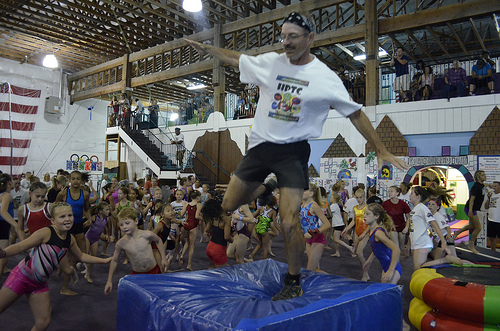
click to watch

Click PLAY or watch it on Facebook.
The FIG Gymnastics for All Committee held a “Join the GfA Activities” course in Negombo, Sri Lanka, on November 23-25, 2017, with the participation of 49 enthusiastic Gymnastics coaches from seven national federations from the Asian Gymnastics Union (AGU), namely Afghanistan, Iran, Jordan, Malaysia, Nepal, Sri Lanka and Thailand.

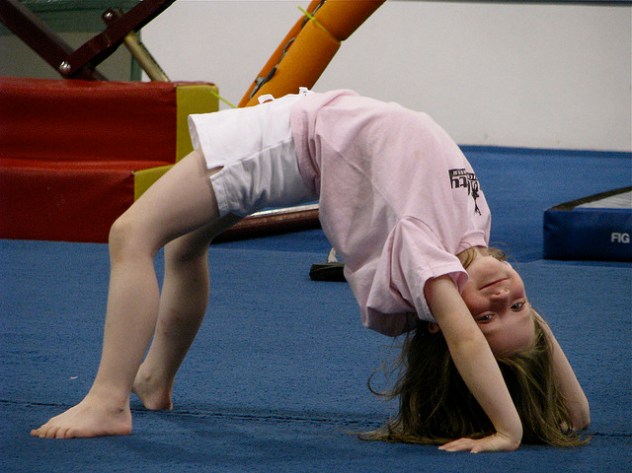
Many children can do a back bend before they get to your first Gymnastics class.
click to see larger original
Some cannot. Some are not strong & flexible enough. Some are still nervous about falling on their backs.
Never force a group of kids to do Bridges. It can be a BIG disincentive for participation.
Instead challenge children to do Bridge activities. Start with activities lying over soft equipment in a Bridge position. Encourage them to work towards Bridges balancing on head, hands and feet (Wrestler’s Bridge).
The final goal is an elevated Bridge. Hands on the floor, feet up on something higher.
Never spot beginners into the Bridge position. Let them discover how to get into position on their own.
Certainly some children will never be able to achieve a proper Bridge. That’s OK.
We teach landing and falling safely FIRST at Gym.
We teach landing and falling safely BEST at Gym.

Of the 6 movement patterns we teach, LANDINGS are the most important.

Children should practice in a padded playground under supervision long, long before they have a bad fall from a bicycle out in the cold, cruel world.
The International Gymnastics Federation calls most non-competitive activities Gymnastics for All.
Not a bad name.
Click PLAY or watch some performance highlights on YouTube.
Their two highlight events are both scheduled every 4 years.
1. World Gymnaestrada
2. World Gym for Life Challenge
Play-it-Forward is a non-for-profit organization located in Calgary, Alberta.
We teach unique and specialized sport and active play programs to children in need. …
To date we have helped over 1500 children through our efforts and hope to expand this number moving forward. …
This is how Darlene “The Bean”, founder of Gymtastics GymTools, gives back for all she’s benefited from Gymnastics.
Click PLAY or watch it on YouTube.
Here’s an interesting fund-raiser:
This auction will be helping Play-it-Forward raise funds to support our upcoming February 2018 project in Tekera, Uganda. This rural community is riddled with poverty, which many of us cannot even imagine. …
We will coach how to ‘Play-it-Forward’ as we ensure to inspire, educate and empower the teachers of the school to carry on the mission. Our volunteers will travel from Calgary to Uganda and will bring and supply the school with thousands of dollars of athletic equipment, T-shirts, play booklets and sport kits for each child, nutritious food and teacher education and training.
Click through for details.
Landon Smith broke his neck at Jump Park Trampoline in January.

We recommend that EVERYONE train with certified, experienced coaches at a Club. Backyard Tramps and drop-in Trampoline Centres are too dangerous.
related – Alberta Injury Prevention Program – Position Statement Private Residence Trampoline Safety


Reply